
Written by Amaan Akhtar
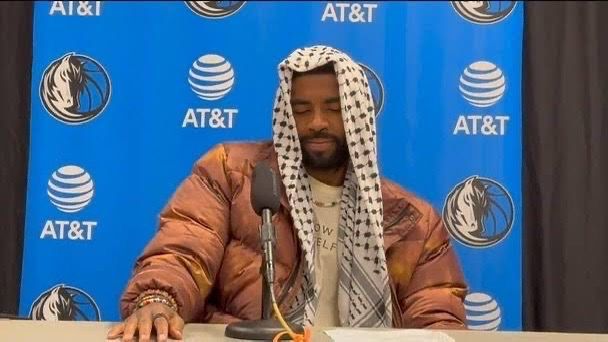
31, 25, 35, 17, 35, 42, 30: That was Kyrie Irving’s stat line during Ramadan, a stretch that once again reminded the basketball world that Irving operates on a different frequency. While fasting from sunrise to sunset, the Dallas Mavericks guard delivered elite performances night after night.
“All praise is due to God, Allah, for this,” Irving said. “For me, in terms of my faith and what I believe in, being part of the Muslim community, being committed to Islam, and also just being committed to all races and cultures, religions, just having an understanding and respect. I just want to put that as a foundation.”
Irving is already one of the most visible and inspirational Muslim reverts in global sports, not just because of what he does on the court, but because of how openly he lives his faith.
Born in Melbourne, Australia, Irving’s journey has never been conventional. When he was just four years old, his mother passed away from illness, leaving his father and aunts to raise him in a Christian household. It was his father who first introduced him to basketball, taking him to professional games and unknowingly setting the foundation for a future superstar.
Irving attended Montclair Kimberley Academy in New Jersey, where he quickly established himself as a force. He became just the second player in school history to score 1,000 points, dazzling audiences nightly with his handle, touch, and creativity. In 2009, he led USA East to a Nike Global Challenge championship and earned tournament MVP honors – a performance that solidified his status as one of the nation’s top prospects and earned him a commitment to Duke University.
At Duke, Irving’s freshman season appeared destined for history. He was the frontrunner for National Freshman of the Year before a ligament injury cut his season short just nine games in. He returned in time for March Madness and reminded everyone of his brilliance, scoring 28 points in a Sweet Sixteen loss.
The Cleveland Cavaliers selected Irving with the No. 1 pick in the 2011 NBA Draft, and he made an immediate impact. He won Rookie of the Year and was unanimously named to the NBA All-Rookie First Team. Resilience became a defining trait. Setbacks never slowed him – they sharpened him.
That resilience was tested again in 2015, when the Cavaliers reached the NBA Finals after the return of LeBron James and the addition of Kevin Love. Irving fractured his kneecap in Game 1 and watched as Cleveland fell in six games. One year later, history repeated itself but this time, the ending changed.
Down 3–1 in the 2016 NBA Finals, Irving and the Cavaliers faced a deficit no team had ever overcome. Irving responded with the defining shot of the series, helping Cleveland win three straight games and secure the franchise’s first championship.
Irving reached the Finals again in 2017 before requesting a trade to the Boston Celtics, later signing with the Brooklyn Nets alongside Kevin Durant and James Harden. It was during Ramadan in 2021 that Irving publicly shared another side of his journey – his commitment to Islam. In one nationally televised game, he broke his fast mid-game with nothing more than a banana and water, then went on to score 30 points.
Since then, Irving has continued to merge elite performance with spiritual discipline. Whether fasting, praying, or speaking openly about issues affecting the global Muslim community – including Palestine – he has become a symbol of faith lived unapologetically at the highest level of sport.
Kyrie Irving’s greatness has never been confined to a box score. It lives in his resilience, his belief, and his willingness to stand firm in who he is. During Ramadan and beyond, he continues to show that faith and excellence don’t compete: they coexist.