


Written by Rayed Qureshi
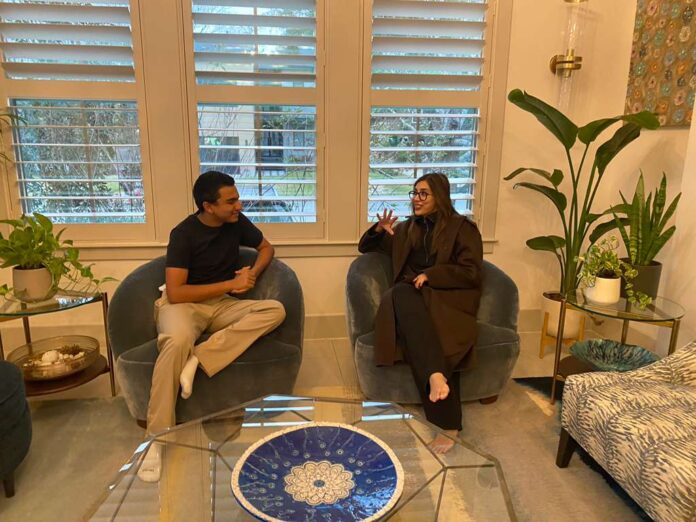
The following is a conversation with local human rights attorney and activist Maria Kari. It has been lightly edited for clarity.
Q. Can you tell us a little bit about yourself?
My name is Maria Kari. I am a Houston-based human rights attorney. I went to law school in Canada, and then I moved to the United States exactly a decade ago, same time that Trump actually rode down that golden escalator in 2016 to announce his first run for presidency. Before moving to the United States, I was in what we call corporate law. The cases I was seeing were cases like BP and Chevron’s oil spills, but I was working on the side of the people who committed the oil spill and coming up with ways to get them out of that legal mess.
I had good mentors, I learned a lot of good skills, but now I have pivoted and dedicated my life to human rights law, and we’re standing up against a system that’s designed to crush and oppress the most vulnerable.
Q. What inspired you to become a human rights lawyer and what keeps you motivated?
My parents tell me that when I was young I was always on a quest to solve cases. I said I was a detective and I made my dad get detective business cards and we would go around trying to figure things out around the house.
In law school, we were all sort of getting groomed to get the best paying job. I was a young brown girl in a small town in Canada, where everybody was white and their parents were lawyers. I ended up getting the best job out of my class on my own merit.
Big law was where I practiced right out of law school and that could have been it. In the summer, I decided to do a summer internship in a law firm in Pakistan. I had to fund it myself, and that was the origin story of how I learned to fund stuff myself.
Once I got there, it opened up my eyes to this world that I had only read about. Until you have walked into those prisons, until you have walked into a death row prison and talked to somebody who’s been sentenced to death, you don’t fully grasp it.
That summer I worked on Pakistan’s death row. I also worked on some Bagram cases, one of the CIA black sites operated after 9/11. You had the waterboarding, the isolation, the music blasting in your ears, the shackled hanging upside down for days.
I’m in my early 20s at this point and I don’t realize that I’m going to represent a woman who had been held at Bagram, in my 30s. That’s Aafia Siddiqui. So it has all come full circle now.
Q. What is the most challenging aspect of being a human rights lawyer?
You’re asking me this in the same week that one of my clients, Asma, was killed. I have taken this week off. I’ve been very much struggling, mentally, with the fact that I have all of this training and knowledge and it all feels useless in the face of unchecked power.
What we’re seeing in terms of how Palestinians are being treated by Israel, how Palestinian Americans are being treated in the United States, and how Muslims have been treated post 9/11 is that the point is cruelty.
We talk to our clients a lot and we know our clients personally. They’re not just piles of paper. All of my colleagues struggle with separating the personal from the professional.
It’s hard when you have a setback like your client being genocided. This case feels like a personal loss because I personally filed her humanitarian parole application. It was denied because they felt that it was not urgent enough. While we were appealing, we got a congressman to support it. So, for this woman to be shredded to death by an Israeli missile feels senseless because we were so close to getting her and her family to safety.
The way you keep going is what a family member of this deceased woman said to me. We both said to each other: “Okay, we’re going to cry right now. Then we’re going to take the day off and we’re not going to do anything. Then we have to get back to work because there’s still a lot of people left alive.”
I don’t have the luxury of being crippled by setbacks. Allah has given me the skillset, the freedom, the flexibility, and the tools to do what I can. The Western model of self-care doesn’t work when you’re working with this level of despair. We’re well past facials and yoga. We’re in a systematic battle against literal tyrants. You just have to have strength, and maybe it’s divine.
Q. What role do organizations like the UN and ICC play in enforcing human rights, and where are they falling short?
Even the most veteran practitioners are now saying the system is broken and flawed. We need these institutions, but the overall system of checks and balances is failing.
When the ICC issues arrest warrants, countries have to act on those arrest warrants of these war criminals, like Netanyahu and Smotrich. If those countries are not going to do their part, then of course ICC is rendered toothless.
That’s why you should never minimize or underestimate the power of local movement building. That’s literally the only thing that works.
For Palestine, that’s one thing I’m seeing play out now in my work. In the case of that woman that was killed, we were going to see good success because there were advocates in California who joined forces with me, took it to the congressman, and got a personal meeting.
We went from them trying to erase Hind Rajab’s story to Brad Pitt now backing the movie that’s been made about her.
When I was filing lawsuits to get Americans out of Gaza, we got 80 people home just by telling their stories on the media. I would file a lawsuit, get on the news with my client, and by the end of that day, the client’s name would be on the exit list.
My work isn’t only for Palestine. It’s also for Aafia Siddiqui, who’s been in jail for over two decades. I don’t know if she will come out of that prison alive.
Instead of getting overwhelmed by it, you pick that one thing where you feel like you can make the most impact. The goal is to stay involved.
Q. Lastly, can you tell us a bit about Project Taha and the work you do through it?
It’s named after Surah Taha. Taha doesn’t have a meaning, or at least a meaning that we are meant to know. But the chapter, the surah, is about peace.
I’m run on community-based donations and bolstered by efforts of excellent attorneys and law students who give their time pro bono.
Attorneys usually bill by six-minute increments. Just having a conversation with somebody for a few minutes is them doing it on the clock and billing you for it.
We don’t do that. We’re saying to the community, if you care about this cause, fund us, and we’ll do the work.
I primarily sue the U.S. government or the state government for wrongs it has done. The community has been generous, Alhamdulillah, and we’re able to make it work.
I take on cases that will have an impact either on policy or law. We took on the evacuation cases, to set a precedent that you owe a constitutional duty to protect U.S. citizens, no matter where in the world they might be. We got Americans out.
Same thing we did with Mahmoud Khalil right now. We’re suing Columbia University and the federal government for giving up records of Mahmoud Khalil and other students to the U.S. government. Khalil had his green card status unlawfully revoked and was detained illegally. These are the cases that move the needle.
So that’s what we do.